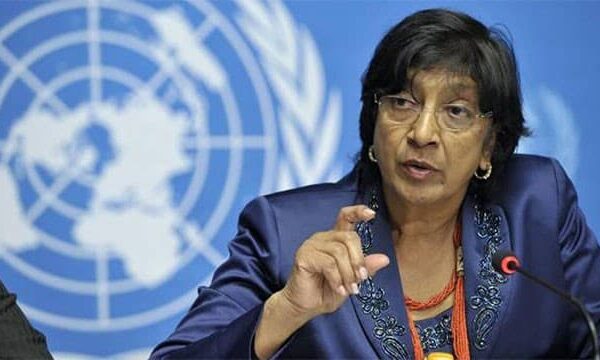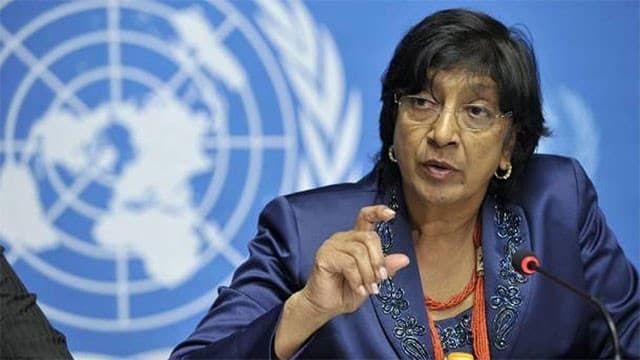
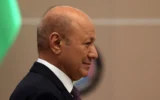
Former UN human rights chief and International Court of Justice judge Navanethem “Navi” Pillay has won the 2026 Nobel Peace Prize for her contributions to international law, the Nobel jury announced on Friday in Oslo, Norway.
She has won for her efforts to promote peace and international law, Jørgen Watne Frydnes says.
Navi Pillay has “significantly enlarged the scope and impact of international law,” Jørgen Watne Frydnes says.
As he announces this year’s winner, he adds Pillay has led the way to “a more comprehensive global legal order,” saying she did so with exceptional courage.
The chair of the Norwegian Nobel Committee goes on to praise her long career, saying she started off as a lawyer in South Africa confronting deep discrimination.
He says she has a “firm moral compass”.
The South Africa-born Pillay, 85 years old, was recognised for her efforts to promote peace and international law, said Jørgen Watne Frydnes, Chair of the Norwegian Nobel Committee.
Pillay served as the United Nations High Commissioner for Human Rights from 2008 to 2014.
In 2013, then UN High Commissioner for Human Rights Navi Pillay conducted a high-profile official fact-finding mission to Sri Lanka from August 25 to August 31, 2013, to evaluate the country’s post-civil war human rights situation.
She had visited northern war zones including Jaffna, Kilinochchi, and Trincomalee, meeting with civil war survivors, families of the disappeared, and local communities.
Pillay reported that Sri Lanka was sliding toward authoritarianism, warned of a persistent climate of fear, and documented the intimidation or harassment of individuals who tried to meet with her.
She also urged the UN Human Rights Council to establish an international inquiry mechanism to investigate alleged war crimes and crimes against humanity committed by both government forces and the LTTE during the final stages of the 26-year civil war.
The Norwegian Nobel Committee in Oslo received nominations for 287 candidates for this year’s prize, and just over a quarter of them are organisations. Experts say the committee typically focuses on the durability of peace, the promotion of international fraternity and the quiet work of institutions that strengthen those goals.
Last year, Venezuelan opposition leader Maria Corina Machado won the Nobel Peace Prize for her struggle to achieve a democratic transition in the South American nation, winning recognition as a woman “who keeps the flame of democracy burning amid a growing darkness”.
Machado gave US President Donald Trump her Nobel medal shortly after the United States ousted then-president Nicolas Maduro. But it was largely a symbolic gesture: the Nobel Committee has said the honour itself cannot be transferred.
This year marks the 125th anniversary of the peace prize, which so far has gone to 112 individuals and 28 separate institutions since its inception in 1901. The Red Cross has won three times and the UN refugee agency twice.
Over the years, the Nobel Peace Prize has been awarded 106 times to 143 laureates, including four US presidents – Theodore Roosevelt, Woodrow Wilson, Jimmy Carter and Barack Obama.
Malala Yousafzai made history as the youngest ever recipient – earning the 2014 Nobel Peace Prize at just 17 years old.
In 1973, Vietnamese politician Le Duc Tho won the prize “for jointly having negotiated a cease fire in Vietnam in 1973” – but he declined to accept it on the grounds that the truce had been violated.
The award has been won by 112 individuals and 31 organisations, including Nelson Mandela, Martin Luther King Jr and Mother Theresa.
-with agencies inputs-