

Shahid Raza
ISLAMABAD : n Pakistan cottage or household industries hold an important position in rural set-up. Most villages are self-sufficient in the basic necessities of life. They have their own carpenters, blacksmiths, potters, craftsmen and cotton weavers. Many families depend on cottage industries for income. Cottage industries have also gained immense importance in cities and towns. There is great demand for hand-woven carpets, embroidered work, brassware, rugs and traditional bangles. These are also considered important export items and are in good demand in international markets.
It is important to encourage cottage and small-scale industries. There are meager resources to develop large-scale industries. However, a program for developing and promoting small-scale industries both in rural and urban areas is more feasible. The advantages of establishing such industries in Pakistan are:
Cottage and small-scale industries are labor intensive and provide employment to 80% of the industrial labor force. This reduces the unemployment and offers opportunities for self-employment.
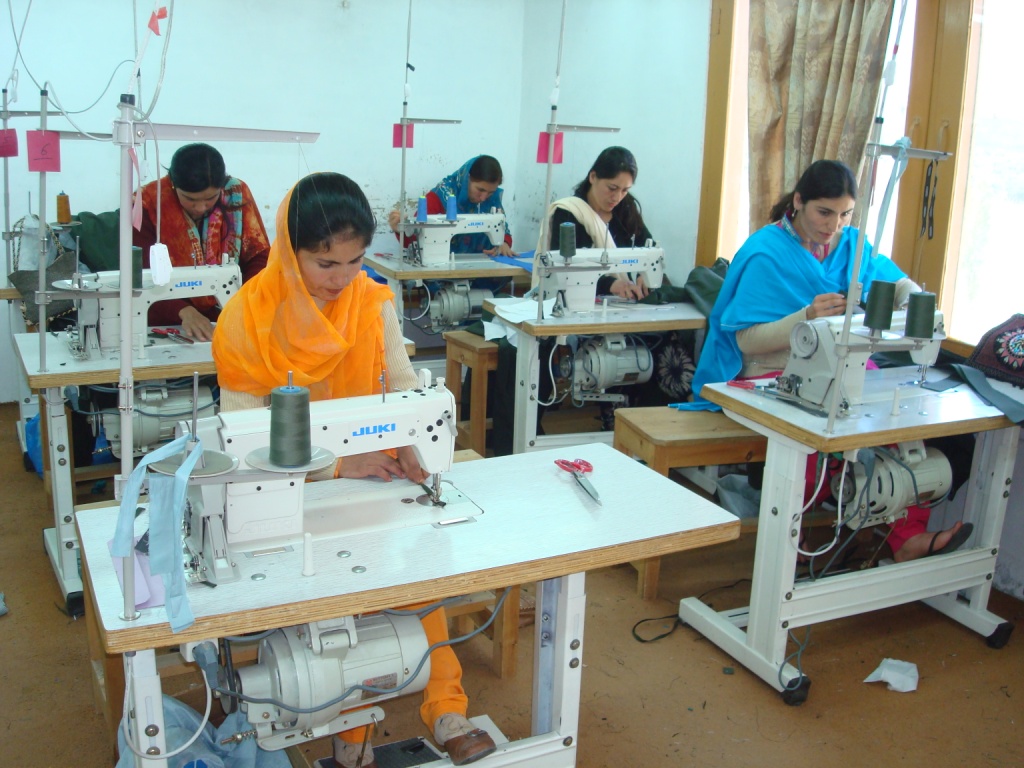
Cottage or small-scale industries like carpet weaving, candle-making and handicrafts can be established in houses and women can be gainfully employed. This increases the active labor force.
These industries also meet the local demands for industrial goods, and save foreign exchange.
There is a demand for rugs, carpets, brassware, handicrafts and embroidered work in the International market. These goods provide 30% of the export receipts of the manufacturing sector. When people are employed gainfully in villages, the migration of people from rural to urban areas will reduce. The problems of housing, sanitation, education, transport and health will also be reduced in urban areas.
Many districts are under-developed. With the expansion of such industries, the regional disparity in income can be reduced.
These industries make effective use of local raw materials which also promotes primary industries like agriculture and mining. Small-scale industry does not require much capital and high technology. This suits to the traditional economic set-up. Cottage and smallscale industries do not use much imported material or equipment.
The waste of large-scale industries, particularly the cotton, sugar and steel industries, can be used to make by-products.
Types of cottage and small-scale industries in Pakistan
There is a web of cottage and small industries in Pakistan. In almost every village, there are a number of such industries depending upon the size of the village and the demand for the products. The establishment of such industry is closely related to the availability of raw material, traditional skills, climatic conditions and, in several cases, the local specialization in the organized factory sector. There is a large variety of handicrafts available in Pakistan. They are not only aesthetically pleasing items, but they also serve the needs of local people.
Some of these industries produce important export items. Recently exports of non-cotton products have faced increasing trade barriers in industrialized countries. However, with corrective measures most of these barriers have been mitigated.
Carpets
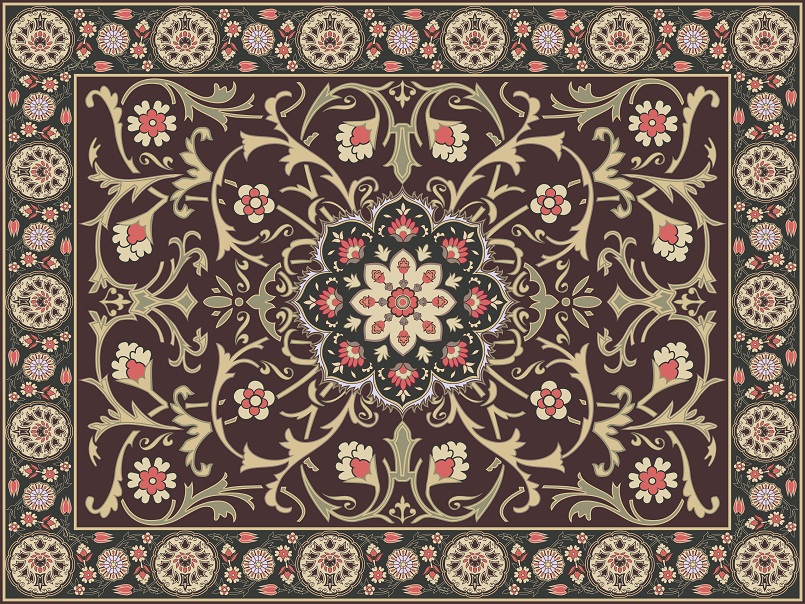
Carpets are by far the most in economic terms and the make a significant contribution to export Earnings. They are generally hand-woven and hand knotted and made of wool, silk or a mixture of the two.
Textiles
Textiles are found throughout the country with a variety of design and techniques. The most famous among them are Khaddar, Susi, Khes, Chunri, Boski, Karandi, Shaal, and Ajrak. The designs are invariably brightly colored with traditional emphasis on blue and red.
Embroidery
Embroidery has developed to a fine art with distinctive regional designs and patterns.
Jewelry
Gold and silversmiths are one of the largest communities of craftsmen. Much of the jewelry made and sold in the cities is intricately fashioned and delicate.
Ceramics
Clay and terracotta pottery and utensils continue to be of great practical importance. Many of the designs of urns, pitchers, bowls, jugs, plates, and pots seen today are almost identical to those uncovered at archaeological sites around the country. Distinctive glazed blue tiles are used to decorate many of the great mosques in Pakistan.
Cutlery
Wazirabad is the city of cutlery industry in Pakistan. This industry is growing day by day and has share of 65 million US dollars in export for 2010. High Quality Damascus Steel ( Pattern Welded Steel ) is manufactured in this city and 95% of world needs are produced here.
Woodwork
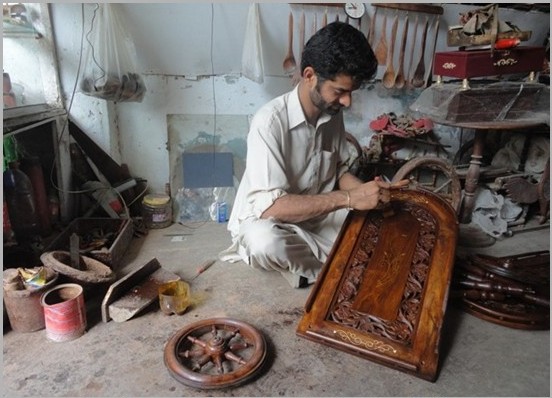
The Swat Valley is perhaps the most famous for its intricately carved architectural woodwork and furniture, although wood-carving is common throughout the northern mountains.
Sports
The main raw material for the sports goods industry is leather and mulberry wood that are available in Punjab. Football, hockey ball, hockey sticks, cricket bats and rackets are mostly manufactured by hand. The skilled workers are available in Sialkot and Lahore. In the industry, large and medium size factories contract work out to small scale and cottage concerns.
Surgical Instruments
Sialkot and Lahore are also noted for the manufacture and export of surgical instruments. The most important raw material is stainless steel which has to be imported. In this industry, also, medium scale factories contract work out to small scale and cottage concerns. Also like the sports goods industry, most of the products are exported.
Sericulture & Silk industry
The cottage industry including sericulture silk has potential to provide employment opportunities to 25 per cent rural population across the province but the farmers have not yet got the government’s support to boost this industry which can bring huge foreign exchange to the country. Presently, about 15,000 families are earning their livelihood from sericulture silk (rearing silkworm) in Punjab while 200,000 more rural families are ready to jump into the sericulture silk production if they get ample support and guidance. Sericulture can play vital role in boosting agriculture and cottage industry. It is most labour-intensive sector that combines both agriculture and industry. The production process of silk contains a large chain of interrelated sections that provide source of livelihood to many layers of people, including, silkworm seed producers, farmers-cum-rearers, reelers, twisters, weavers, and spinners of silk waste, traders and others. Silk provides rich dividends with low investment, and it can provide returns throughout the year. Natural Silk Yarn, Fabrics Made-ups, Readymade Garments, Silk Carpets and Silk Wastes are the major goods for exports.
Fans’ Industry
Fans have been manufactured in Pakistan since its inception in 1947 mainly clustering in the four major cities namely, Gujrat, Gujranwala, Lahore and Karachi with product line includes ceiling, pedestal, and table bracket, exhaust, and louver fans. Some of the leading importers from Pakistan include Bangladesh, which accounts for 47.8% of Pakistan’s domestic fans exports, Saudi Arabia has 18.7% share followed by UAE, with 17.3% share. The domestic fan category shares 29% of total fan exports. Traders involved with fans industry has been facing major threat from big manufacturers, such as Germany, China, Japan, USA and Taiwan exporting nearly 70% of the total international market of fans industry while the industry in Pakistan has been declining.
Other small-scale industries
Other small scale industries include electric fans, cutlery and general engineering. Load shedding, though, has adversely affected the big industries, yet it helped small industry to grow. Small manufacturers, who were actually exploiting load shedding, are getting handsome amount by making emergency lights, candles, generators, UPS and many other electric items.
Government Policy towards Small-scale and cottage industries
The government is fully aware of the potential of cottage and small-scale industries for industrial development. The following organizations have been established to develop this sector of economy:
Pakistan Small Industries Corporation (PSIC), Punjab Small Industries Corporation (PSIC), Sindh Small Industries Corporation (SSIC), The Small Industries Development Board KPK (SIDB), The Directorate of Small Industries Balochistan (DSIB).
The above organizations are taking the following measures:
Establishment of industrial estates.
Providing marketing facilities.
Setting up technical service centers.
Establishing handicraft development centers and carpet centers.
Providing pre-investment counseling and guidance to newcomers.
Providing local and foreign loans to small industry owners on easy installments.