


COLOMBO : Christmas is not merely the remembrance of the historical birth of Christ, but a feast that calls to mind the promise of hope He gave us — the promise of His return. It is worth reflecting on why the birth of one person has been celebrated throughout the world for over 2,025 years. This is not due to any ordinary reason, but because of the great wisdom that was born with Christ, the law of God that came into being with Him and that holds sway over the entire universe, the spirituality of forgiveness and altruism that was born with Him, and the unique philosophy of life that emerged with Him.
This philosophy teaches that the one who desires to be first must become last; that the secret of gaining is letting go; and that to be a leader does not mean wearing crowns and receiving honor, but becoming a servant who washes the feet of others. Through these teachings, Christ introduced to the entire universe a life pattern that is both spiritual and profoundly blessed. For this reason, His birth has been celebrated in the past, is celebrated today, and will continue to be celebrated for all time.
Thus, the birth of Christ and the deep spiritual way of life that was born with Him are inseparably bound together. Therefore, it is impossible to reflect on the birth of Christ without also reflecting on that spiritual way of life.
As we all know, God created the world and placed our first parents, Adam and Eve, in the Garden of Eden. However, by disobeying God’s command, they opened the doors of their lives to Satan. They allowed the darkness of Satan to enter into their relationships. The result was the destruction of the first family: Adam and Eve became estranged from one another. This did not stop there; their son Cain murdered his brother Abel. The first family was destroyed, and the Garden of Eden was lost.
Yet, God’s plan of salvation was not something He abandoned or left unfinished. Therefore, the dream that was blurred in the Garden of Eden was re-established by God in Nazareth of Galilee. What Adam and Eve were unable to accomplish, God fulfilled through Joseph and Mary. Hence, it is not incorrect to describe Christmas as the Feast of the Family. This family feast invites every household to close its doors to Satan and open them to God.
Christmas is a feast of reconciliation. That is why it is also understood as a feast of peace. For peace to exist, there must first have been conflict; for reconciliation to take place, relationships must have been broken. Sin has always generated conflict and shattered relationships. In this world, relationships can be broadly categorized into four types: the relationship between God and humanity; the relationship between human beings and their neighbors; the relationship between humanity and nature; and the inner relationship each person has within himself or herself. Sin destroyed all four of these relationships.
However, when God was born as a little child in a manger, it was precisely these broken relationships that were healed and restored. Within the manger lies the Good News: God has re-established His relationship with humanity. God has become human and has been born into this world through the womb of a human woman. The broken relationship between God and humanity has been restored. The relationship between human beings and their neighbors has been healed. Poor shepherds, wealthy and learned scholars, and kings gathered together under one roof. Moreover, the hay, the star, the sheep, and the cattle all proclaim that humanity and the whole of nature have once again been reconciled. At the same time, the human person has been healed inwardly, moving toward a serene, contemplative, and harmonious existence. Thus, all four relationships that were once broken were restored in the manger.
The most profound event that took place at Christmas is the revelation that, through God becoming human, there exists within humanity the possibility of divinity — the unveiling of the divine nature hidden within human existence. A human being is not someone who should be confined by divisions of color, party, race, or caste. Within every human person lies a wondrous divine likeness and image. Humanity possesses the potential to become godlike. This potential was revealed and reached its fullness on Christmas Day.
There is abundant testimony to this truth. Those who came as kings returned as scholars. Poor shepherds became the first witnesses to the great miracle of the birth of Christ. Mary, a young woman of about sixteen from the town of Nazareth, became the Mother of God. Joseph, a young carpenter who fashioned furniture from wood, became the earthly guardian of Christ. All of this culminated in God Himself becoming fully human like us. In all these individuals, the hidden divinity within them came to light. Therefore, Christmas is the feast of the great transformation in which the divinity hidden within humanity was revealed.
Because of the birth of Christ, world history was divided into two. History changed from “Before Christ” to “Anno Domini.” Not only world history, but human history itself began to be written anew.
For this reason, it is appropriate to meditate on where your Christmas is. Although the historical Christmas took place in Bethlehem, Peter’s Christmas — that is, the moment Christ was born within Peter — did not occur in Bethlehem. It took place on the Sea of Galilee. Paul’s Christmas occurred on the road to Damascus. Zacchaeus’ Christmas did not happen in Bethlehem, but beneath the sycamore tree. Mother Teresa of Calcutta experienced her Christmas when she heard the voice of the Lord inside a train compartment in Italy.
All the saints tell us about the profound Good News contained within the birth of Christ. Therefore, when is your Christmas? Where is your Christmas? Has Jesus been born within you? Does your life story contain two distinct realities — before you recognized Christ and after you recognized Him? The Christmas of such a person is truly meaningful and rich in significance.
This year, Christmas holds special meaning for us due to the natural disaster that recently struck our country. Many people ask whether there is Christmas this year, or how Christmas can be celebrated. However, we must remember that even at the first Christmas, Joseph, Mary, and the infant Jesus were a displaced family. When the Mother of God cried out in the pain of childbirth, people closed the doors of their inns to them. Because they were displaced, they were forced to give birth to the child in a stable where animals were kept.
Although three kings once came bearing gold, frankincense, and myrrh, this year we witnessed groups of kings carrying rice, dry rations, and clothing — not on camels, but in vehicles and on foot — searching for Christ present in displaced children. While only a few shepherds once stood watch to dispel the loneliness of that night, today thousands of people, including the tri-forces, have reached these displaced families by land, sea, air, and through mountain paths. Though floods swept away clay statues and decorated mangers, today the entire nation has been transformed into a living manger.
Therefore, Christmas is not merely the celebration of the birth of the Infant Jesus, but a feast in which the birth of forgiveness, reconciliation, peace, and inner transformation also took place together with Him. In other words, all these realities were born as His twin companions. Thus, let us celebrate a meaningful Christmas in Christ and allow ourselves to be transformed. Let us rise. Let us give space to the divinity hidden within our humanity.
May you have a Blessed Christmas!
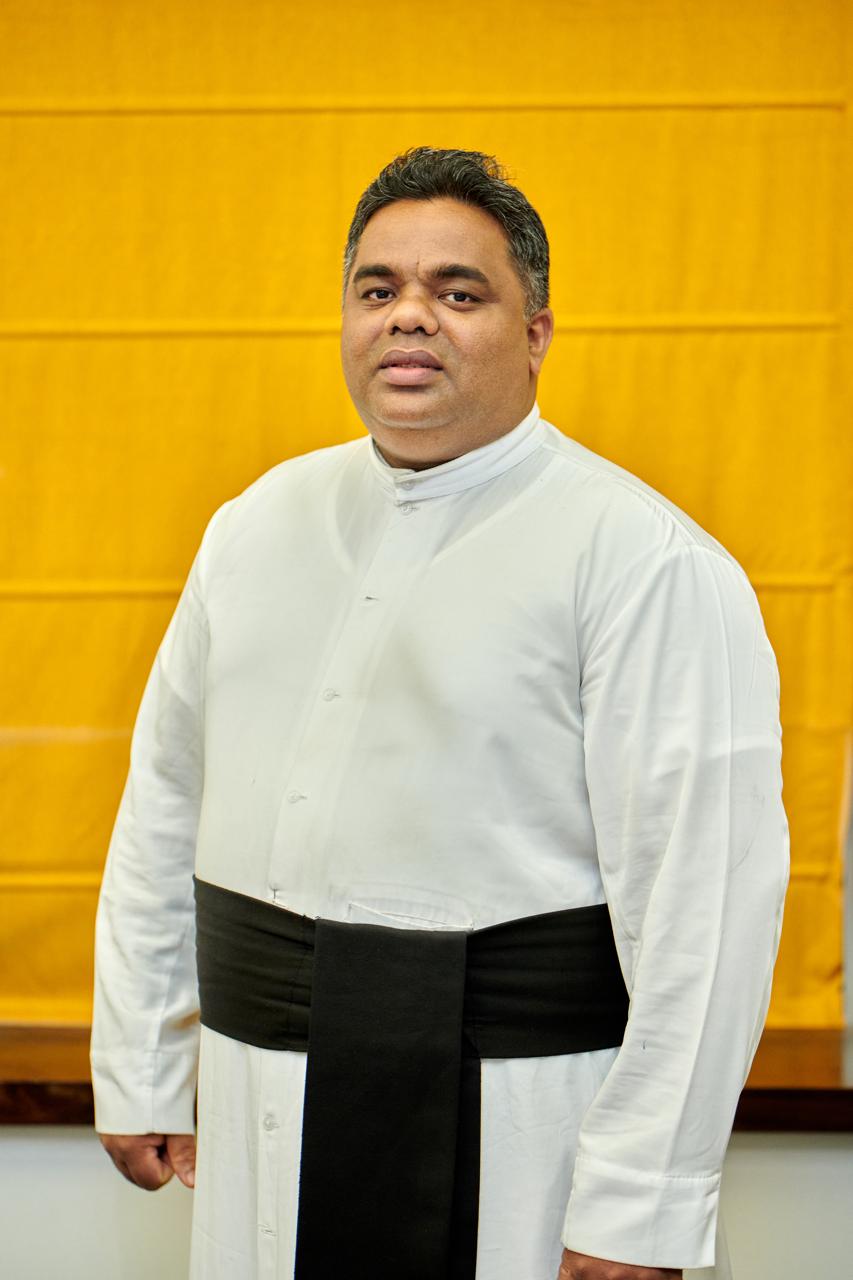
Rev. Fr. Prasad Harshan
Rector,
St. Aloysius Seminary,
Colombo 08


