


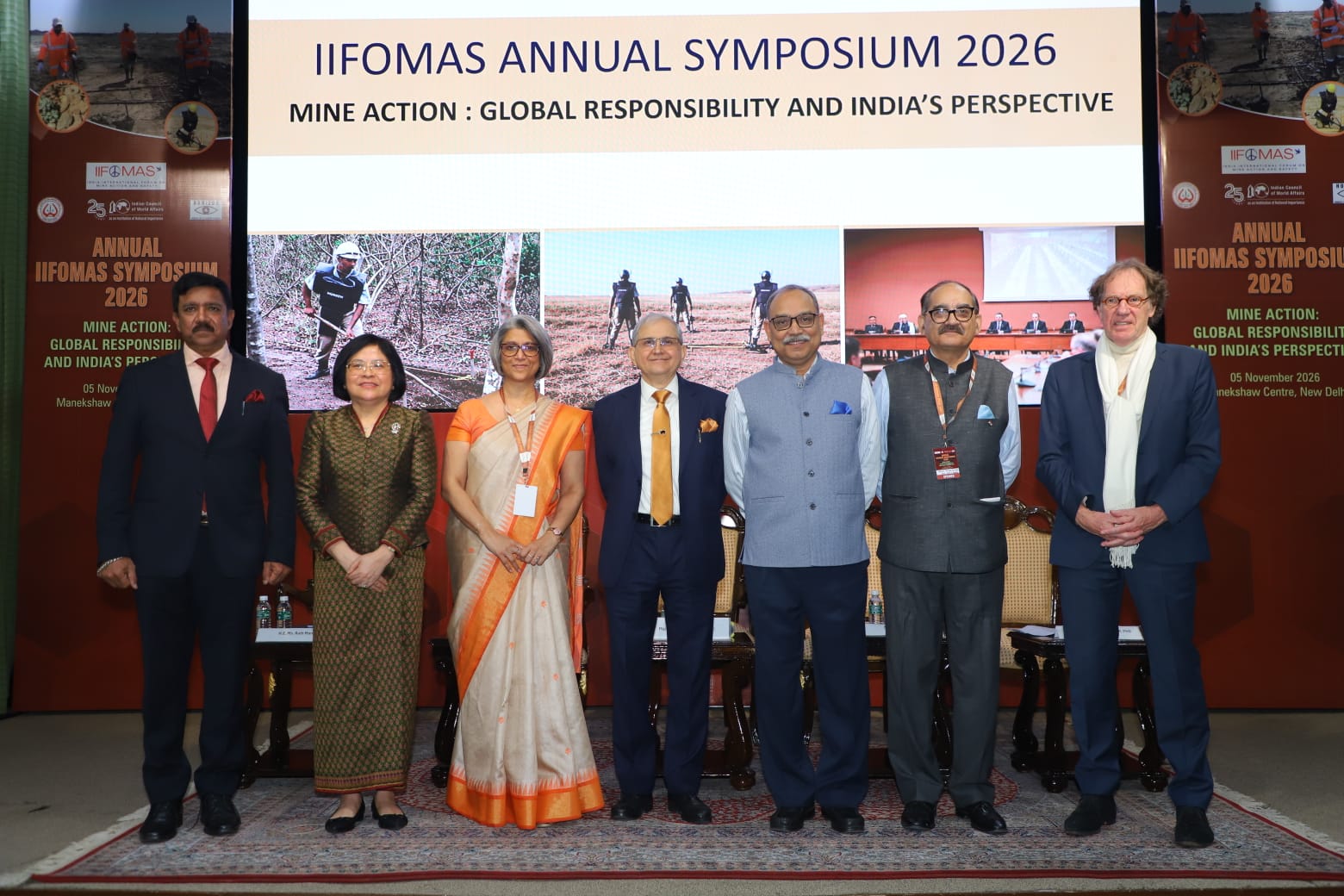
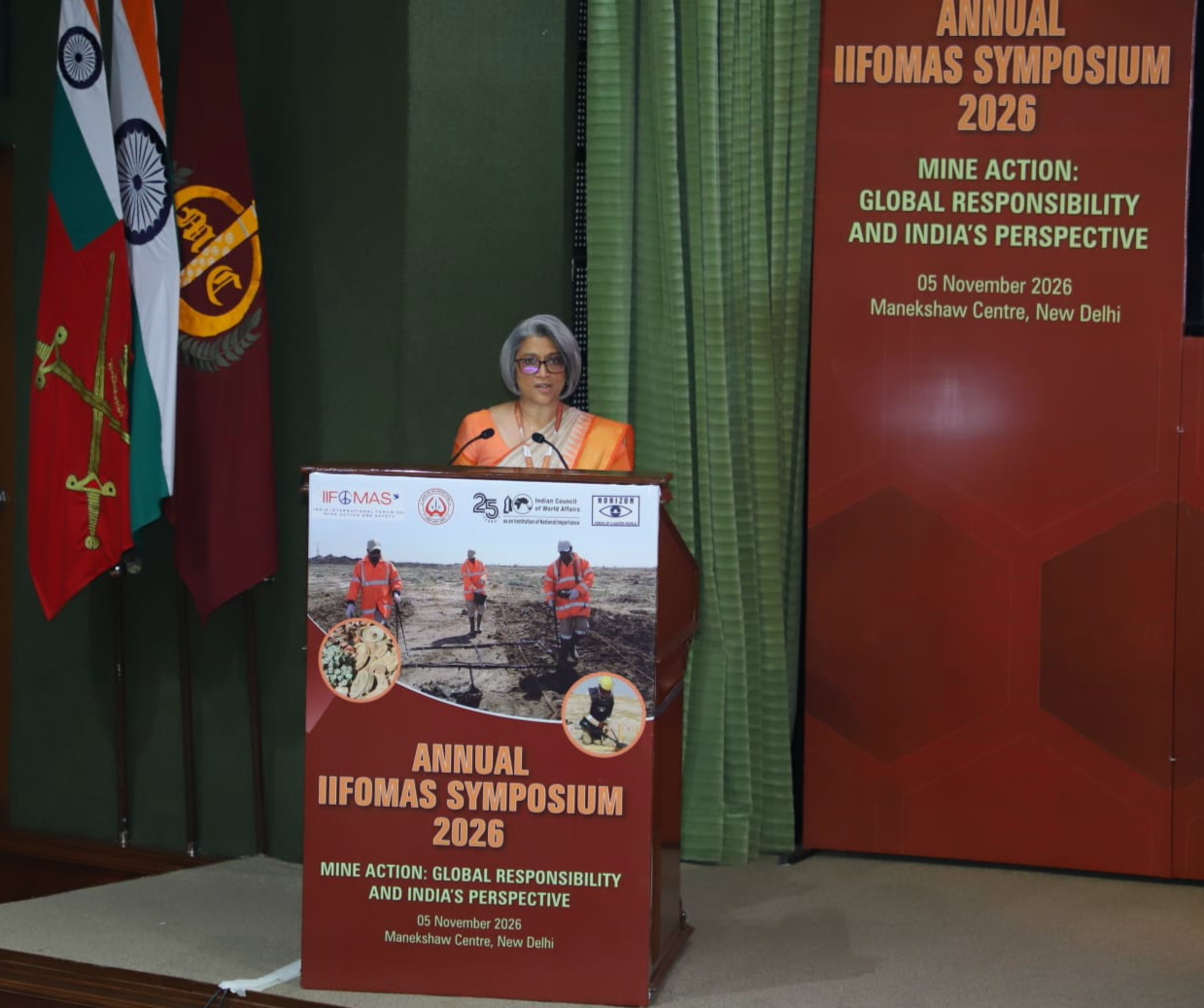
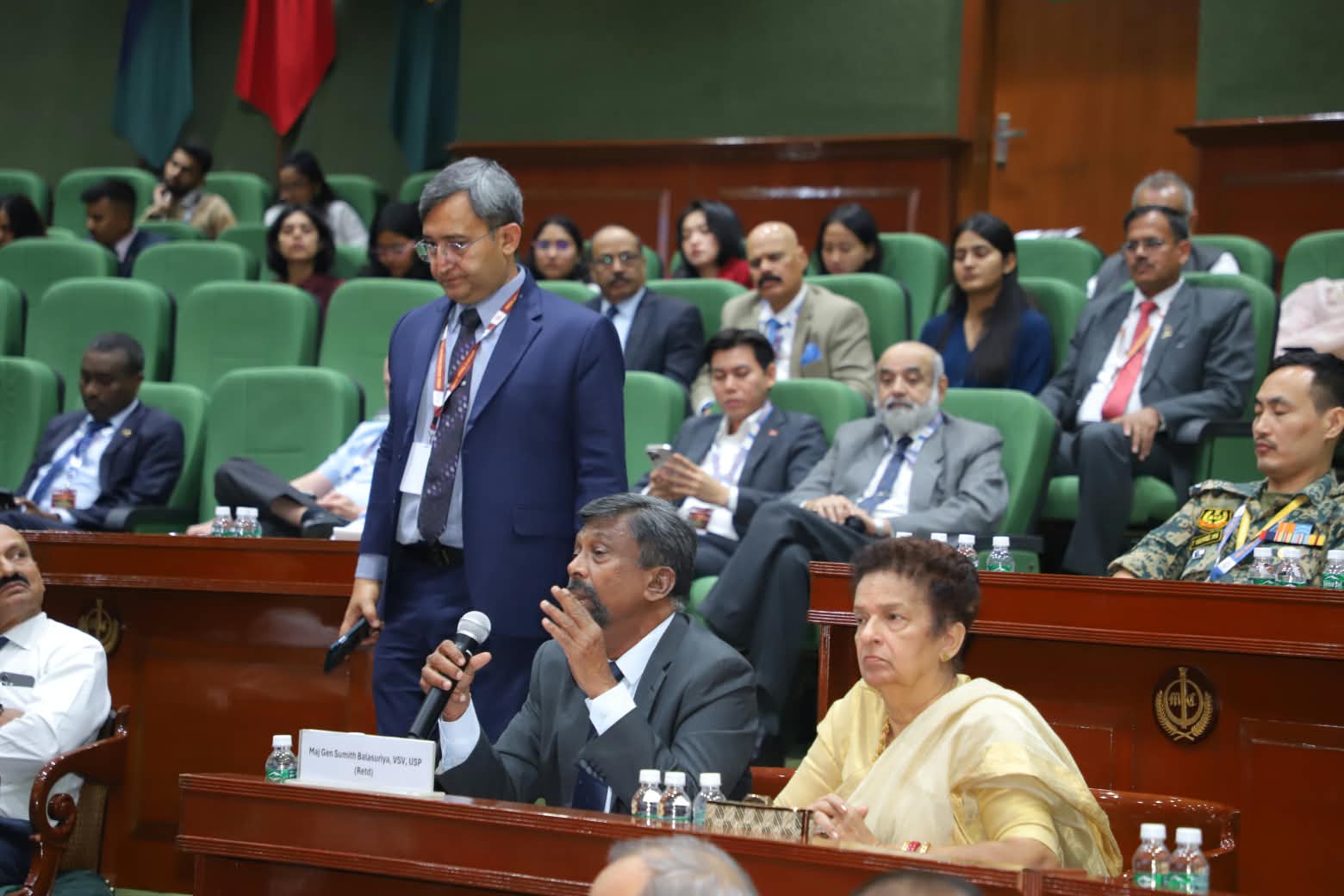
NEW DELHI : Sri Lanka highlighted its experience in humanitarian mine action and the importance of sustained international cooperation at the Annual Symposium of the India International Forum on Mine Action and Safety (IIFOMAS), held in New Delhi on 5 November 2026.
The symposium, themed “Mine Action: Global Responsibility and India’s Perspective,” brought together senior Indian defence and foreign policy representatives, diplomats, international experts and practitioners to discuss the evolving global mine-action agenda and India’s role in humanitarian assistance, capacity-building and post-conflict recovery.
The conference was organised by IIFOMAS under the Horizon Safer World Foundation, with the financial support of the Indian Council of World Affairs (ICWA) and participation from the Centre for Land Warfare Studies (CLAWS).
High Commissioner of Sri Lanka to India, Mahishini Colonne, participated as a panellist in the session on “Global Mine Action Agenda: Responsibilities and Opportunities.” The panel also featured Ambassador of Cambodia to India Rath Many; Distinguished Fellow at the International Centre for Counter-Terrorism, Netherlands, Peter Knoope; and Senior Defence Analyst Maj Gen Rajan Kochhar (Retd). The session was moderated by Maj Gen Ajay Seth (Retd), Chairman of the IIFOMAS Board.
In her remarks, the High Commissioner shared Sri Lanka’s experience in addressing the humanitarian, social and developmental consequences of landmines and explosive remnants of war. She emphasised that humanitarian mine action goes beyond the physical removal of mines, as the release of safe land enables the return of communities, resettlement, livelihoods, agriculture, infrastructure, investment and broader local development.
She noted that Sri Lanka has made substantial progress in its national mine-action programme. According to the National Mine Action Centre, 20.28 square kilometres of contamination remained as at 30 September 2026, following the release of more than 233 square kilometres of land since the commencement of the programme. The remaining areas are increasingly challenging, with contamination located in remote forested areas, former defensive positions and other difficult terrain. The remaining figure may also change as completion surveys identify previously unknown contamination.
The High Commissioner noted that the final phase presents a different set of challenges from the earlier stages of the programme, with the average cost of releasing a square metre of land having increased significantly while international donor funding has declined.
She further stressed the importance of adopting a whole-of-Sri Lanka approach to the final phase of mine action, involving not only the Government, the National Mine Action Centre and demining organisations, but also the private sector, financial institutions, technical and educational institutions, civil society, and affected communities. Such an approach would help ensure that land released through demining is effectively connected to resettlement, livelihoods, agriculture, infrastructure, employment and investment, thereby translating humanitarian mine action into lasting economic and social benefits.
The High Commissioner also highlighted India’s longstanding contribution to Sri Lanka’s humanitarian demining efforts, including the role played by Indian demining organisations in helping release contaminated land for communities affected by the conflict. She expressed the hope that India would continue to stand by Sri Lanka as it works towards completing the journey towards a mine-free Sri Lanka.
Sri Lanka’s participation in the 2026 symposium followed its participation in the previous IIFOMAS symposium in 2025, which focused on “Mine Action: Clearing Danger to Development.” The continuing engagement reflects Sri Lanka’s interest in sharing its experience while strengthening international understanding and cooperation on the final stages of its humanitarian mine-action programme.


