


RUZAIK FAROOK
COLOMBO —
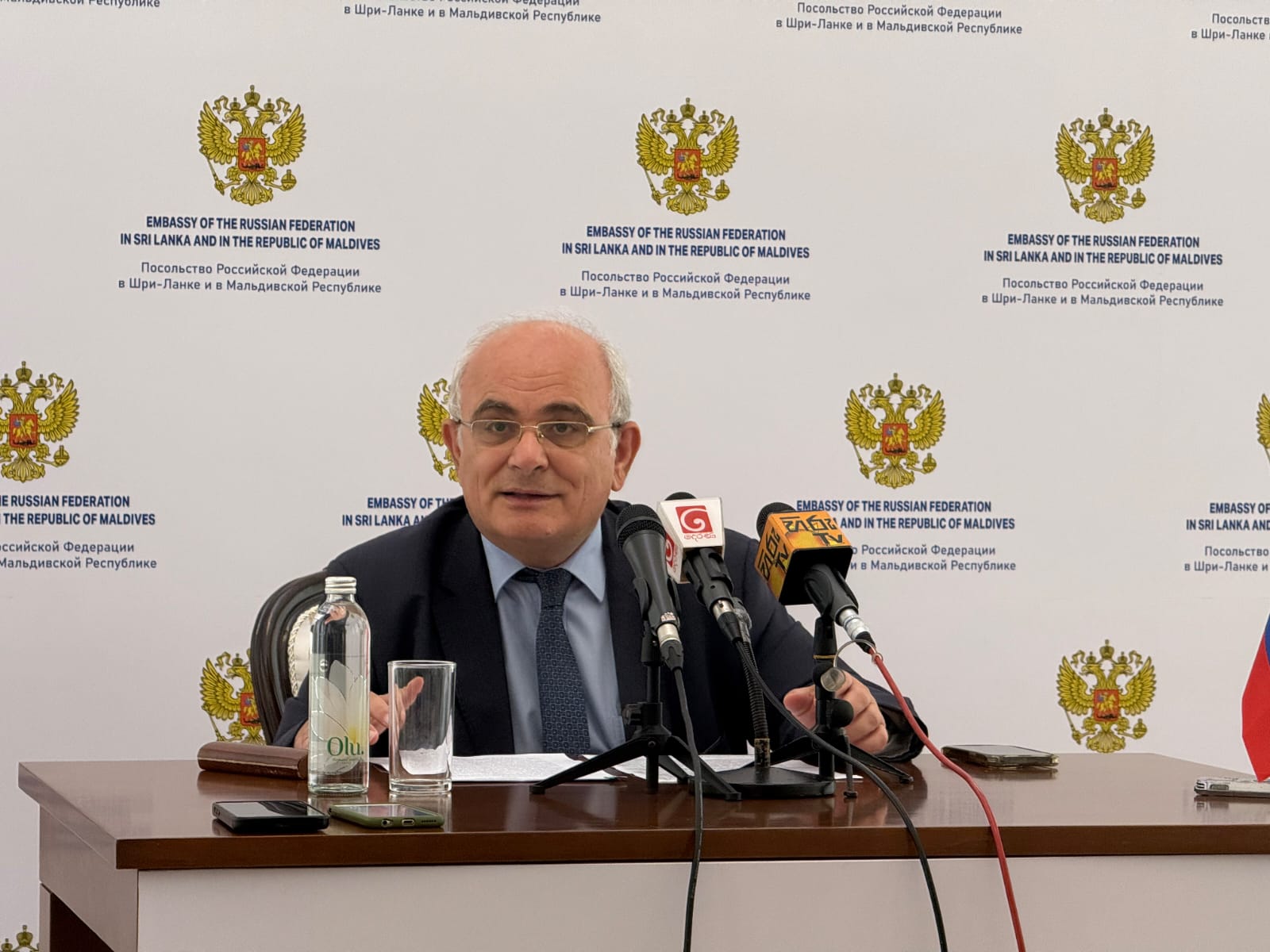
Ambassador of Russia to Sri Lanka and Republic of Maldives Levan S. Dzhagaryan addressed the media at the annual Press-conference held at the Embassy on Wednesday February 18.
The Ambassador said at the press I will speak about various aspects of the Ukrainian crisis. As our President Vladimir Putin has consistently emphasized, Russia remains committed to a diplomatic resolution. A review of the conflict’s history, from its origins in 2014 and especially since 2022, reveals no shortage of goodwill from the Russian Federation regarding political settlements. Yet, our Western, primarily European, neighbours have taken deliberate steps to undermine these agreements. They are employing the same tactics towards initiatives put forward by the US Trump administration, seeking to dissuade it from reaching an understanding with Russia.
Statements from European leaders – be it Kaja Kallas, Ursula von der Leyen, Friedrich Merz, Keir Starmer, Emmanuel Macron, or Mark Rutte – makes it clear that they are seriously preparing for a war against the Russian Federation, and they make little attempt to conceal it. Russian position on Ukraine is that any resolution must address the root causes of this crisis, which the West has deliberately cultivated for years to transform Ukraine into a security threat against Russia.
They have actively encouraged the openly Nazi regime that seized power through the 2014 coup to embark on a path of legally and physically suppressing all things Russian – from education and language to culture, media, and the canonical Ukrainian Orthodox Church.
Following the unconstitutional coup d’état in 2014, the nationalist leaders of Ukraine unleashed a war against the people of Donbas. This forced us to take retaliatory measures to protect our people there and in Crimea.
Based on the desire to resolve the conflict peacefully, Russia agreed to conclude the Minsk agreements in the Normandy format with the participation of Ukraine, Germany and France. As it turned out later, François Hollande and Angela Merkel had no intention of implementing the provisions from the very beginning and wanted to gain time to militarily strengthen Ukraine. Before the start of the Special Military Operation, we repeatedly called on our partners to resolve this problem taking into account the interests of the Russian population in Donbas and respect for Russian security concerns. However, all these efforts were arrogantly rejected.
We had no choice but to launch the Special Military Operation on February 24, 2022. Soon after, the negotiation process began in Istanbul. As a result an agreement was prepared and initiated, and its text satisfied Ukraine. However, the then Prime Minister Boris Johnson arrived in Kiev and called for not fulfilling the agreements, but waging war “till the last Ukrainian”.
In addition, at the end of September 2022, Volodymyr Zelensky signed a decree by which he himself forbade negotiations with the Russian Federation. Besides, Zelensky is an “expired” president, because, according to the Constitution of Ukraine, he lost legitimacy back in May 2024.
With the arrival of Donald Trump, a new opportunity window has opened. The negotiations should be conducted on the basis of principles of equality, mutual respect and with taking into account the situation at the front.
In June 2024, Vladimir Putin outlined 4 conditions for completion of the Special Military Operation:
- Demilitarization, denazification of Ukraine;
- Neutral, non-aligned, non-nuclear status of Ukraine;
- Recognition of Crimea, Sevastopol, Donetsk People’s Republic (DPR), Lugansk People’s Republic (LPR), Kherson and Zaporizhia regions as integral part of Russia;
- Lifting all Western sanctions against Russia.
I would like to note that despite Zelensky’s illegitimacy, we are ready to negotiate with him, though the question of his signature arises, if and when such agreements are reached.
It is noteworthy that there is no unity in the EU’s plans for a peaceful settlement of the Ukrainian crisis. There are countries, such as Slovakia, that are in favor of the negotiation process. But there are also “hawks”: Great Britain, France, Poland, Baltic states, NATO Secretary General. We have often heard that they are ready to assist Ukraine as much as it needs. I personally have already heard this in relation to Afghanistan, when Western leaders have repeatedly declared their readiness to provide assistance to the Ashraf Ghani regime. We know how it ended. In August 2021, the Americans and their allies fled the country after a shameful defeat by the Taliban movement.
There is a question of trust here. We have been deceived many times, with the Minsk and Istanbul agreements, so there can be no talk of a ceasefire or freezing the conflict. We need a lasting peace that ensures the security of Russia and Ukraine. And most importantly: Russia will not tolerate any language of ultimatums.


