


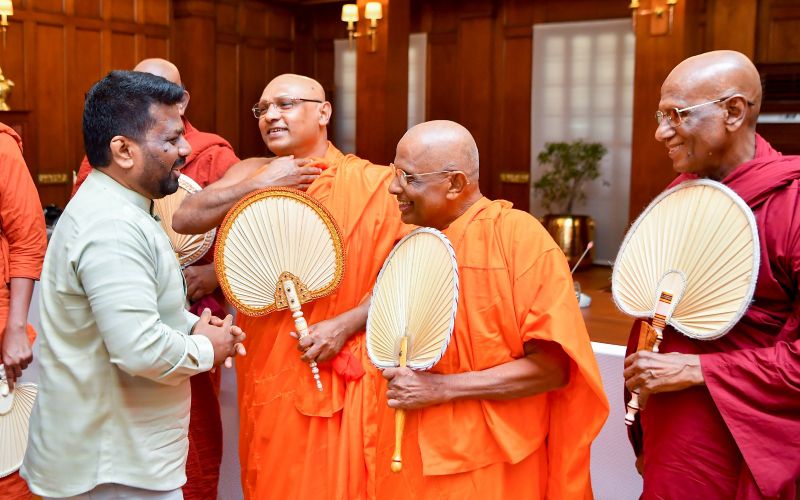
COLOMBO : President Anura Kumara Dissanayake stated that a committee would be appointed to review and amend the existing laws governing the manner in which Buddhist monks are detained in prisons and taken outside prison premises, and to introduce new standing orders and regulations.
The President stated that the committee would comprise representatives of the Attorney General’s Department, the Ministry of Justice, the Ministry of Public Administration, the Ministry of Buddhasasana Affairs, prison officials and the Commissioner-General of Prisons. The committee would be tasked with studying the matter and submitting amendments within two weeks. He added that the provisions affecting Buddhist monks would be discussed with the Maha Sangha and amended accordingly.
The President further stated that he was not prepared to issue orders for individuals while laws were in place and emphasised that if existing laws were not appropriate to the present circumstances, the proper course of action was to duly formulate and amend the law.
President Anura Kumara Dissanayake made these remarks while participating in a special discussion with the Maha Sangha at the Presidential Secretariat this afternoon (08).
The discussion was held to consider the letter addressed by the Mahanayake Theros to the Commissioner-General of Prisons regarding the action taken by the Department of Prisons to remove the robes of Ven. Galagodaaththe Gnanasara Thero and present him before the court in lay attire, as well as the situation that has arisen in society in connection with this incident and the measures that should be taken in the future to prevent similar situations.
The President expressed his respect and appreciation to the Maha Sangha for joining the discussion at his invitation.
President Anura Kumara Dissanayake, while further explaining the existing prison laws, stated that
“Currently, our prisons are governed by the Prisons Ordinance enacted in 1877. The Ordinance has been amended from time to time. Section 94 of the Ordinance empowers the Minister to issue regulations from time to time, and these regulations were also amended in 2022. In addition, the Commissioner-General of Prisons has the authority to issue standing orders for the administration of prisons, subject to the approval of the Minister. Accordingly, the prison system is governed by the Ordinance, regulations issued by the Minister and standing orders issued by the Commissioner-General, subject to the approval of the Minister.
With the exception of one or two provisions, the focus has been on ordinary prisoners. It is only in Regulation 216 that specific reference is made to Buddhist monks. Therefore, when these laws were formulated, specific regulations were not developed with Buddhist monks or other religious dignitaries as the focus. The focus has always been on ordinary prisoners.”
There are two categories of persons who enter prisons. One category consists of those held on remand, meaning persons who have not been convicted and sentenced by a court. This issue does not arise in relation to Buddhist monks held on remand. However, the situation changes when a person is convicted by a court and becomes a prisoner. There are two types of imprisonment in this regard: rigorous imprisonment and simple imprisonment. In the case of a sentence of simple imprisonment, a prisoner may choose clothing with the approval of the prison superintendent. However, in the case of rigorous imprisonment, the prescribed clothing provided by the prison must be worn. Until now, action has been taken in accordance with this law.
Accordingly, based on the letter submitted by the Mahanayake Theros, the issue arises not so much in relation to how Buddhist monks are held in prison, but when they are taken outside the prison. This should be taken into consideration on every occasion when they are taken outside the prison, not only for court proceedings. This is because, while the inside of a prison is a closed environment, once they are taken outside, they become exposed to the media and the general public.
This procedure has been followed when taking these individuals outside the prison. I also looked into the situation regarding the 63 Buddhist monks currently in prison. In some cases, Buddhist monks serving sentences for one offence have to be brought before courts in connection with other cases. Some of the monks currently serving prison sentences have also been brought before courts in connection with other cases without wearing their robes.
As prison officials have acted in accordance with the existing laws and regulations, there is no purpose in blaming them.
I acknowledge that it is deeply shocking and distressing for Buddhists and the Maha Sangha to see a monk whom they respectfully paid homage to yesterday being seen in a different manner today. However, this is the procedure that was followed.
Laws are not eternal or unchanging historical entities, they are regularly amended. Therefore, my venerable Theros, I do not wish to issue an order saying, ‘Although the law exists in this form, do this instead.’ In such a situation, the law is set aside and it becomes my law. My personal wishes should not become the law. Although in ordinary politics it is said that ‘the law is the will of the ruler’, I have absolutely no desire to make my will the law.
If the law is not appropriate to the present circumstances, what should be done is to duly enact and amend the law, rather than implementing the law according to our wishes. Therefore, these existing regulations and prison standing orders should be amended to suit the present circumstances. It is through discussions such as this that such matters come to light. These laws have always been formulated to address general circumstances, and there are few specific regulations concerning Buddhist monks.
As it was not anticipated that Buddhist monks would be imprisoned, such regulations may not have been included. However, it now appears that Buddhist monks have also, to some extent, become affected by the deterioration that has taken place in society. Therefore, new rules should be formulated regarding the manner in which Buddhist monks are held when imprisoned and the manner in which they are taken outside the prison. These should apply to the system as a whole and should not target any one monk,” the President stated.
The Maha Sangha present at the discussion, on behalf of the Mahanayake Theras, expressed their gratitude and blessings to the President for taking the necessary steps to provide prompt solutions by addressing such sensitive matters.
The event was graced by the presence of the Maha Sangha representing the three Nikayas: Most Venerable Narampanave Ananda Thero, Anunayake of the Asgiri Chapter of the Siyamopali Maha Nikaya, Most Venerable Pahamune Sri Sumangala Thero, Chief Secretary of the Malwatu Maha Vihara Chapter of the Siyamopali Maha Nikaya, Most Venerable Mahawela Sri Rathanapala Thero, Deputy Secretary, Most Venerable Balapitiye Sirisivali Thero, Chief Secretary of the Sri Lanka Amarapura Maha Nikaya, Rajakiya Panditha and Darshanapathi, Most Venerable Ahangama Maithreemurthi Thero, Deputy Secretary and Shasthrapathi, Venerable Attangane Sasanarathana Thero, Chief Secretary of the Sri Lanka Ramanna Maha Nikaya, and Most Venerable Kongasthanne Ananda Thero.
Minister of Buddhasasana, Religious and Cultural Affairs Dr Hiniduma Sunil Senevi and Minister of Justice and National Integration Attorney-at-Law Harshana Nanayakkara also participated in the event.


