


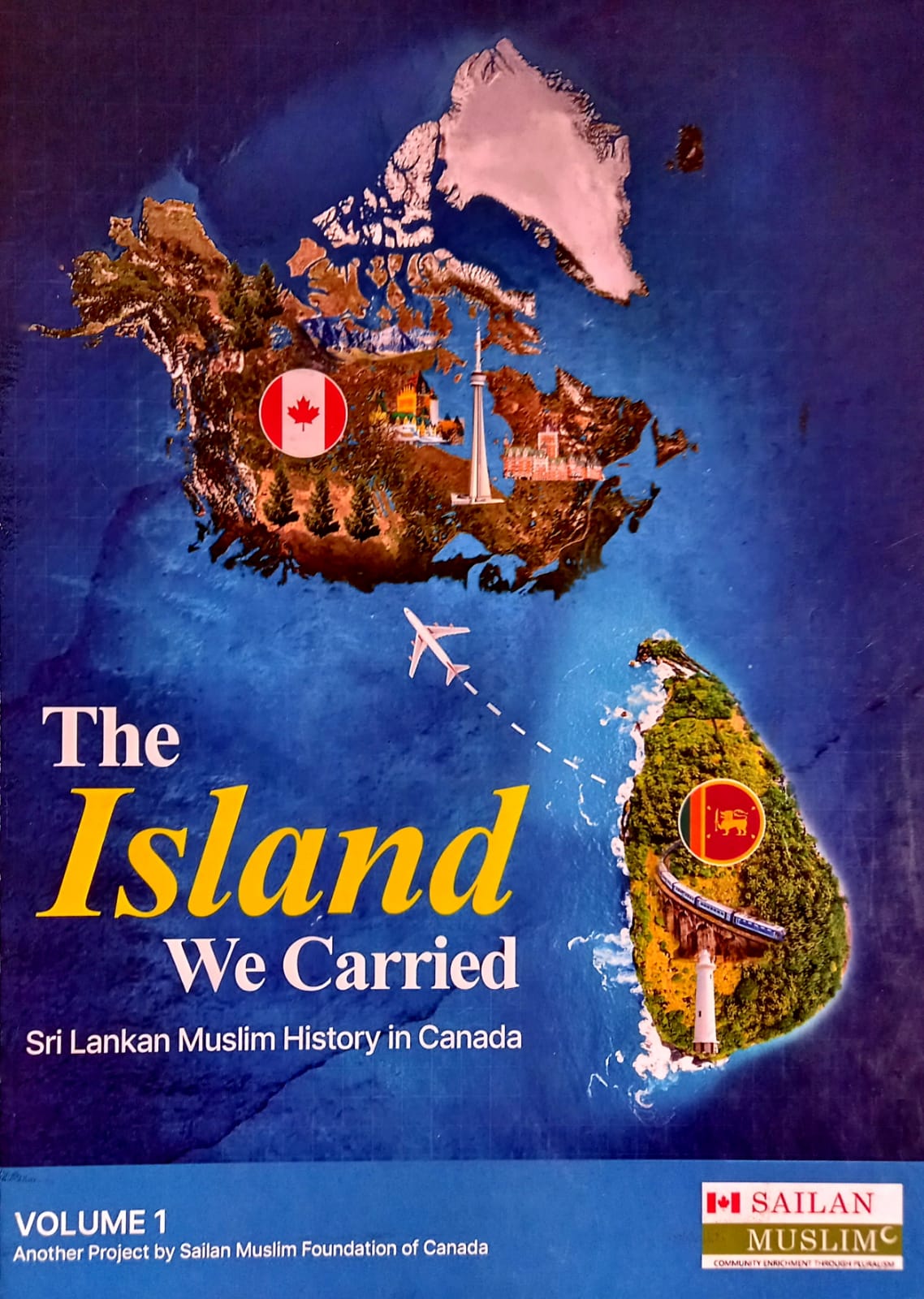
Published by Sailan Muslim Foundation, hard cover, pp.220 (illustrated in colour)
Reviewed by Asiff Hussein
This work is a pioneering attempt to record the life stories and contributions of the first lot of Muslim immigrants who left the shores of Sri Lanka to settle in Canada. Painstakingly compiled and wonderfully curated in the form of a coffee table book by a dedicated team of professionals, it traces the arrival of these pioneer immigrants and records how they seamlessly integrated into Canadian society while retaining their roots. It is an interesting case study of a migrant community that never forgot its roots and as such makes fascinating reading. To document it for posterity is a most commendable task.
It was ten years ago, in the fall of 2016, that I was invited on a lecture tour to Canada by the Sailan Muslim Foundation and I must say I was quite impressed by the unity of the Sri Lankan Muslim community there. This is something I never expected to find in a migrant community. Their sense of identity and belonging was truly remarkable and this was expressed in a number of ways, not the least having regular get-together parties at the homes or out-houses of the member choosing to host the event which took place once a month or so, one of which I had the fortune of attending and fraternizing with the invitees, great times indeed!
This well illustrated work complete with both older monochrome photographs and more recent colour photographs traces the arrival of nearly thirty migrant families in chronological order beginning from the first arrivals in the 1960s and shares with us their success stories by sheer dint of hard work. In short, it does two things, firstly it pays tribute to those pioneering individuals who made their way there and did well, paving the way for others to follow in their train, and secondly it inspires future generations by recording their stories which bring out the best in them.
Also very importantly, the work is a valuable resource for researchers, especially those studying issues of migration and integration, particularly within the Sri Lankan context. It shows how a community could successfully blend into the fabric of the host country while preserving their close-knit social life and religious and cultural traditions and at the same time stopping short of total assimilation.
The life stories of these early migrants makes compelling reading beginning with the stories of first generation immigrants such as Thowfeek Doray, the son of Saifuddin Aniff Doray, the renowned scholar who translated the Islamic treatise Fathud Dayyan into English and Entrepreneur ZAM Bari whose German-born son, nicknamed ‘Schokolade baby’ in German after his brown skin went on to become the first Sri Lankan medical Doctor in Canada. Also fascinating is the story of Engineer AGA Barrie who was born in the old Moor town of Beruwala and went on to become Canada’s first engineer of Sri Lankan origin. The story of the rest of his family also makes a most interesting read recounting their struggles and achievements as the years rolled on.
What I also found fascinating were the reminiscences of the more senior immigrants even before they set foot on Canadian soil, including the account of Captain Azad Hamid who grew up in the garrison town of Diyatalawa and who recalls his childhood days there such as running around the green rounded hills covered with pine and eucalyptus trees, going fishing and being taught by the renowned British educator W.T.Keble who was the author of a well known travelogue back then, Ceylon Beaten Track, not to mention the Captain’s Royal College days where he excelled as a cadet before joining the Sri Lanka Army. As enthralling are the reminiscences of Rolls Royce Engineer Sameem Ashroff whose account of life in the London of the swinging sixties where he studied makes captivating reading with the Beatles, Supermarkets, Colour Television and the subway known as The Tube thrown in for good measure.
Particularly interesting is the story of Chemical Engineer Rahumathullah Marikkar who grew up in Dharga Town, Aluthgama whose innovative spirit was kindled quite early on in childhood, taking things apart to see how they were made starting with his Kodak camera and at eighteen trying his hand at soap-manufacture, making his own soap stamp using the old spring blades of a car and casting the stamp, and then going on to sell the soap and friends in the late 60s. Moving on to Wellawatte Spinning and Weaving Mills, he would observe what he calls ‘a crime against nature’ with the huge factory polluting the air and water and turning the adjacent Wellawatte Canal into a cesspool of dead fish.
Ever the wiser after this experience, he would focus on sustainable development and after migrating to Canada in the 1980s went on to producing environmentally-friendly carpets with his innovative contributions as a chemical engineer at a factory in Belleville, prompting others to jump into the eco-friendly bandwagon.
And then there’s Fareez Farook who gives a most vivid account growing up in his hometown of Matale whose father went from the Ceylon Police Force to become a well known entrepreneur, manufacturing Padmini Bar Soap, running a grinding mill and even starting a batik workshop. His parents passion for reading was inherited by the little boy whose lifelong relationship with the printed word began with a Phantom Comic which oddly enough was the first book he truly read. Fareez would go on to become a leading IT professional working for a Japanese firm, but never lost his passion for books, amassing a collection of, believe it or not, 26,000 books!
As fascinating is his account of his family of five’s arrival in Canada under the surreal summer light of those northern climes twenty five years ago, stepping into a world they had known only through the whispered pages of books and the shimmering illusions of cinema, half imagined, half believed, and suddenly startingly real. The account of the family’s early days in Canada is also noteworthy as it gives much insight into moving in to a new homeland, all of it captured in a very engaging and unforgettable style.
It will be evident from the above accounts that many of those who had made landfall in Canada to begin a new life there had already made their mark in life here or elsewhere. What prompted them to move to Canada was certainly not a lack of love for the motherland which they recall with nostalgia and a sense of belonging, but various other reasons which should constitute a study in itself, which this book gives some insights into, hence its importance.
Indeed one also comes across in this book, stories of immense struggle in the early years such as the hard life some had to endure adjusting to the new conditions and even cases of couples who had to do odd jobs just to make ends meet. In fact one lady speaks of the heartbreaking loss of the warm embrace of her family back home and remarks that Canada, though full of promise, was not as ‘green’ as she had envisioned, with the early days being very tough, which however the young couple overcame with the support of the local migrant community already well established there.
Although the Muslim community was still small at that time, it was vibrant and brimming with hope. Most importantly the pioneers of the growing community supported those who migrated later making those early years less daunting. Now, those very same people who share their early struggles quite frankly in this work also go on to give a brighter account as their new life in Canada improved with time.
One account speaks of the solitary Jamia Mosque founded in an old church building on Boustead Road and a single Halal beef store nearby. Later times saw the emergence of five more mosques as the community flourished that included a couple of mosques built by the Sri Lankan Muslim community including Masjid Al-Taqwa and Jannah Masjid in Toronto where I lectured on the cultural contribution of Sri Lankan Muslims. We also learn how over time more shops and restaurants emerged catering to Sri Lankan tastes including not just Halal fare but also vegetarian fare which Muslims could freely consume. Another account, after telling of a brief life of struggle goes on to give a vivid picture afterwards, holidaying with the kids, enjoying nature and digging up dinosaur bones in the Bad Lands.
Perusing the pages of this most captivating work, the reader cannot help but get away with the impression that the pioneer immigrants had indeed won the day, helping the community to come of age, evolving from the small close-knit group they were back then to become the thriving community they are today.


